Concepts
This page explains the key ideas behind SilverSpoon-KD’s design.
Knowledge distillation
Knowledge distillation trains a smaller student model to reproduce the behavior of a larger teacher model. The teacher is frozen during training; only the student’s parameters are updated.
There are two broad families of approaches:
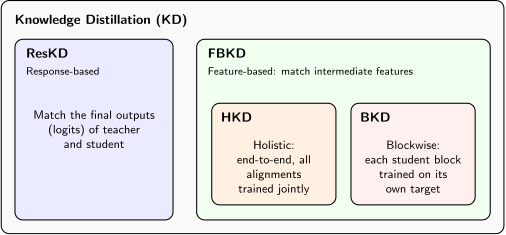
Response-based distillation (ResKD) matches the teacher’s output logits using temperature-scaled soft targets (the classic Hinton et al. approach).
Feature-based distillation (FBKD) matches intermediate representations (hidden states, attention outputs, etc.) between teacher and student layers.
SilverSpoon-KD supports both. The diagram below shows how these paradigms relate:
Response-based distillation (ResKD)
Response-based KD matches the teacher’s and student’s final output logits. It’s the simplest form of distillation and requires no alignments.
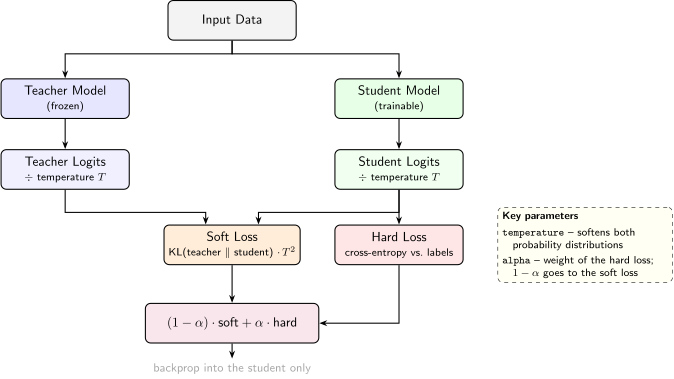
The ResponseBasedDistiller implements Hinton et al. (2015) soft-label distillation:
where (\mathcal{L}{\text{soft}}) is a user-provided loss function (e.g.
temperature-scaled KL divergence) and (\mathcal{L}{\text{hard}}) is the
model’s own task loss (outputs.loss). (\alpha) controls the balance between
soft and hard losses. The soft loss function is passed to the distiller
constructor — any callable with signature (student_logits, teacher_logits) → scalar.
Feature-based distillation (FBKD)
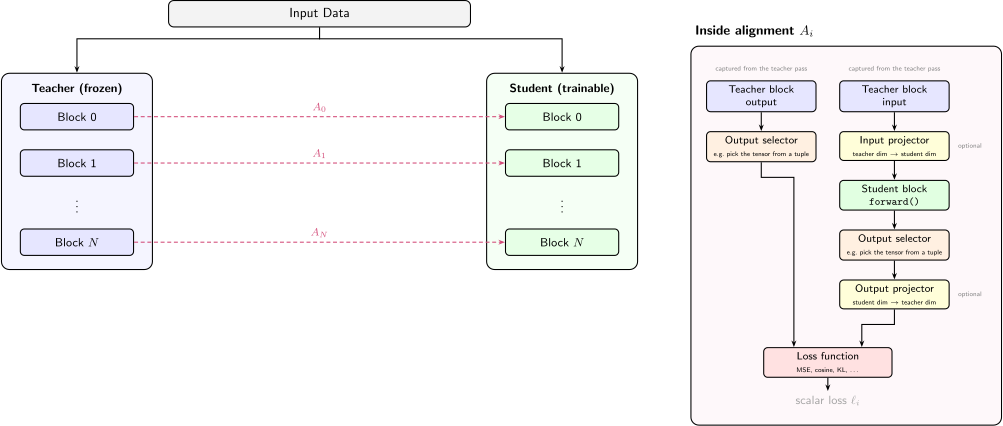
FBKD (used by HolisticDistiller and BlockwiseDistiller) matches intermediate layer representations via
alignments. Each alignment pairs a teacher block with a student block and
defines how to compare their outputs.
Alignments
An alignment pairs one teacher module with one student module and defines how they are compared during training.
Alignment
├── teacher_block: nn.Module          # the teacher layer to capture
├── student_block: nn.Module          # the student layer to train
├── teacher_output_selector: callable        # optional output selector (e.g., tuple extraction)
├── student_output_selector: callable        # optional output selector
├── loss_function: callable
├── loss_weight: float (default 1.0)  # per-alignment loss contribution weight
├── optimizer / scheduler
├── input_projector: nn.Module (optional)
└── output_projector: nn.Module (optional)
Each Alignment carries its own optimizer, scheduler, and loss function,
so different layer pairs can use different training configurations.
Terminology
- Alignment
A pairing of one teacher block with one student block, plus the output selector(s), projector(s), loss function, optimizer, and scheduler for that pair.
- Output Selector
Extracts a single tensor from a tuple output, e.g.,
(hidden_states, attn_weights)→hidden_states. No trainable parameters. (OutputSelectorclass)- Input Projector
A learned
nn.Linear(ornn.Conv2d) that maps the teacher’s output dimension to the student’s input dimension, so the student block can process teacher-sized activations. Used in blockwise distillation.- Output Projector
A learned
nn.Linear(ornn.Conv2d) that maps the student’s output dimension to the teacher’s output dimension, so the loss function can compare them.- Auto Projector
When
auto_projector=True(the default), projectors are automatically inferred and created on the first forward pass if a dimension mismatch is detected.
Output selectors
When a module returns a tuple (e.g., (hidden_states, attention_weights)),
output selectors pick the element to compare. OutputSelector(index=0) extracts
the first element. You can also pass any callable.
Projectors
When teacher and student layers have different hidden dimensions, a projector bridges the gap. SilverSpoon-KD provides linear and conv2d projectors that are trained alongside the student:
GenericLinearProjector– projects along the feature dimensionGenericConv2dProjector– projects along channel dimensions
Set auto_projector=True on an Alignment (the default when using
create_alignments) to let the library detect shape mismatches on the first
forward pass and create projectors automatically.
Tip
Auto-projectors default to PyTorch’s kaiming uniform initialization. You can
change this via the projector_init parameter on create_alignments or
Alignment: pass "normal" (std=0.02, BERT-style), "xavier" (Xavier
uniform), or any callable fn(module) for custom initialization.
Loss weighting
Each alignment has a loss_weight (default 1.0) that scales its contribution
to the total loss. This lets you emphasize certain layers — for example, giving
later layers higher weight:
alignments[0].loss_weight = 0.25  # early layer — low priority
alignments[1].loss_weight = 0.50
alignments[2].loss_weight = 1.00  # final layer — high priority
Only the ratios between weights matter, not their absolute values.
Weights [2, 3, 5] produce the same gradient proportions as [0.2, 0.3, 0.5].
Weights do not need to sum to 1.
Magnitude-aware weighting
When loss magnitudes differ across alignments (e.g., one layer’s loss is 1000
while another’s is 10), the larger loss dominates gradient updates even with
a smaller weight. Enable magnitude_aware_weighting to normalize each loss by
its current magnitude before applying weights:
args = TrainingArguments(
    ...,
    magnitude_aware_weighting=True,
)
With magnitude-aware weighting, the total loss becomes:
where \(\operatorname{sg}\) denotes stop-gradient (.detach()). Each component’s
gradient is scaled by \(w_i / |L_i|\), ensuring gradient contributions are
proportional to weights regardless of loss magnitudes.
Note
Magnitude-aware weighting changes the total loss scale to approximately
sum(weights). Learning rates may need adjustment. Per-alignment raw
losses are still logged separately for monitoring convergence.
Warning
loss_weight is supported by HolisticDistiller only.
BlockwiseDistiller will emit a warning if non-default weights are set.
ResponseBasedDistiller uses its own alpha parameter for soft/hard
weighting and also supports magnitude_aware_weighting.
Distillation strategies
BlockwiseDistiller
Trains each aligned layer pair independently. For every training step:
Run the teacher forward pass and capture outputs at each aligned module.
For each alignment, run the student block on the teacher’s captured inputs.
Compute the loss between student and teacher outputs.
Backpropagate and update that student block’s parameters.
Because each block is trained in isolation, gradients never cross block
boundaries: every block receives direct supervision from its teacher
counterpart and has its own optimizer and scheduler. With
backward_per_block=True in TrainingArguments, the backward pass runs after
each block instead of after summing all block losses, which keeps peak memory
at a single block’s worth.
HolisticDistiller
Runs full forward passes through both teacher and student models, captures intermediate activations, computes alignment losses across all layers, and performs a single backward pass. This allows gradients to flow across layers, which can be important when cross-layer interactions affect distillation quality.
ResponseBasedDistiller
See Response-based distillation (ResKD) above.
Capture engine
The ModuleCaptureEngine registers PyTorch forward hooks on specified modules
to record their inputs and outputs during a forward pass. Distillers use this
to obtain teacher (and sometimes student) activations without modifying model
code.
With auto_truncate=True, the engine stops the forward pass as soon as all
captured modules have produced their outputs. For example, if a 24-layer
teacher is aligned at layers 0–5, layers 6–23 are skipped entirely — saving
both compute and memory. The option is off by default (auto_truncate=False)
on ModuleCaptureEngine, BlockwiseDistiller, and HolisticDistiller:
truncation works by raising an exception from the last capture hook, which is
incompatible with FSDP and torch.compile.
Tip
If you only align an early subset of layers and train on a single GPU or with
DDP (without torch.compile), pass auto_truncate=True to the distiller for
a speedup — the teacher forward pass exits as soon as the last aligned module
has run.
Note
When a model is FSDP-wrapped and needs a backward pass (the student in
HolisticDistiller), the distiller forces auto_truncate off for that model
and logs a warning. A forward-only FSDP-wrapped teacher can still be truncated.
Loss functions
All losses follow the signature (student_output, teacher_output) -> scalar:
Name |
Aliases |
Description |
|---|---|---|
|
Mean squared error (default) |
|
|
Z-score normalized MSE (matches relational structure, ignores scale) |
|
|
Cosine similarity loss ((1 - \cos(s, t))) |
|
|
Smooth L1 / Huber loss |
|
|
|
KL divergence (with temperature scaling and optional chunking) |
|
Jensen-Shannon Divergence (with temperature and interpolation weight) |
|
|
Project through LM head, then KL divergence on token distributions |
|
|
InfoNCE-based contrastive distillation loss |
|
|
Decomposed angular (cosine) + magnitude (norm) loss |
|
|
|
MSE under a learned Mahalanobis metric |
|
|
Cosine loss under a learned Mahalanobis metric |
|
RelKD distance-wise distillation |
|
|
RelKD angle-wise distillation |
|
|
|
Combined RelKD distance + angle loss |
Use silverspoon_kd.get_loss_function(name, **kwargs) to retrieve a loss by name.
The function is available at the top-level package import. Loss-specific
hyperparameters (e.g., temperature, weight_matrix) are passed as keyword
arguments.
Utilities
SilverSpoon-KD provides several utility functions for common model preparation tasks. See the Utilities guide for detailed usage.
reconfig_model
Creates a new model with a modified configuration (e.g., fewer attention heads or a smaller intermediate size) while preserving the same model class. Optionally copies matching weights from the source model and freezes them.
prune_model
Performs structured pruning using importance-based weight selection. Uses
Torch-Pruning’s DependencyGraph to discover parameter couplings and propagate
pruning correctly. A two-pass algorithm handles attention heads separately from
MLP width to avoid dependency graph cycles.
freeze_parameters
Freezes model parameters whose names match any of the provided regex patterns.
Use thaw_not_matched=True to also unfreeze parameters that don’t match.
Distiller factory
The Distiller factory function creates the appropriate distiller by string name:
from silverspoon_kd import Distiller

distiller = Distiller(
    distiller_type="blockwise",  # or "holistic", "response_based"
    teacher_model=teacher,
    alignments=alignments,
    train_dataset=train_dataset,
    args=args,
)
Short aliases are also accepted: "bkd" (blockwise), "hkd" (holistic),
"reskd" (response-based).